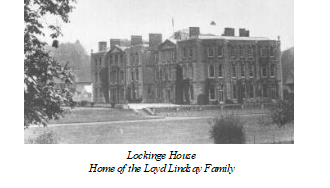
The name of the Lodge originates from the local Loyd-Lindsay family and, in particular Lord Wantage – Robert James Loyd Lindsay (Baron Wantage of Lockinge)
Robert James Loyd-Lindsay, VC, lived at Lockinge House two miles east of Wantage. He was the husband of Lady Wantage who inherited the Lockinge Estate through her Father, Lord Overstone.
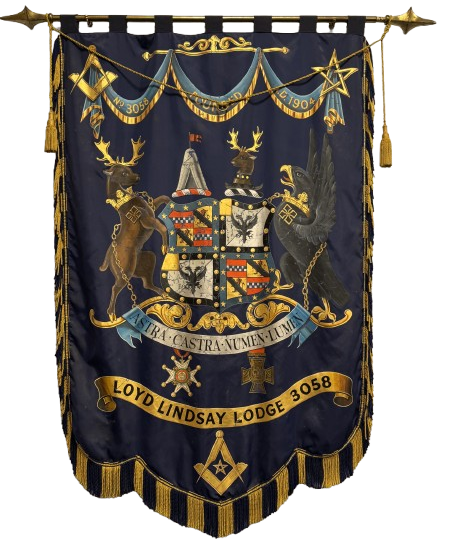
There were no children of the marriage. Unfortunately, at the death of Lady Wantage in 1920 the title ceased to exist. The heir to the estate was a cousin – Mr. A.T. Loyd (W.Bro. A.T. Loyd, PM) whose family still owns the estate. The motto by which they lived was included on their Coat of Arms – “ASTRA CASTRA NUMEN LUMEN” – (The Stars are my Tent, God my Light) and was adopted as the Loyd Lindsay Lodge motto.
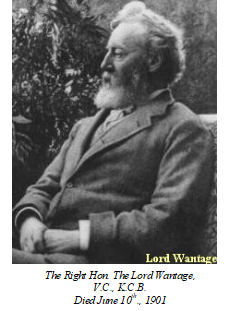
Lord Wantage began his career in the Army, entering the Scots Fusilier Guards in 1850 and served throughout the Crimean War, where he obtained the Victoria Cross for gallant deeds at Alma and at Inkermann. His well known defence of the Queen’s Colours at Alma is commemorated in his last gift to the town of Wantage, the Victoria Cross Gallery Pictures. Shortly after his return from the Crimea he was appointed Equerry to the young Prince of Wales. After leaving the Army he entered Parliament in 1865 and sat for twenty years as Conservative Member for Berkshire until he was raised to the Peerage in 1885, becoming Baron Wantage of Lockinge. He was, for fifteen years, Lord Lieutenant of Berkshire, and as such took the lead in County work and in all important County movements. He was closely connected with the Volunteer movement from its formation, as Colonel of the Royal Berks Volunteers, and subsequently as Brigadier-General of the Home Counties’ Brigade. He filled the office of Financial Secretary to the War Office from 1877 to 1880, and throughout his life maintained an active interest in all Army matters. At the time of the Franco-German War he founded the English Red Cross Society and personally organised and directed his work in many subsequent campaigns, including the War in South Africa. These and numerous public duties did not cause him to neglect work nearer home. He was Chairman, and Manager, of a large commercial enterprise (started by a near relative of his) — The London Electric Supply Corporation, which he steered successfully through many difficulties. At his Berkshire home he was associated with almost all the useful undertakings of the neighbourhood, such as the Wantage Tramway Company, the Wantage Coffee House Company, King Alfred’s School, The Wantage Cottage Hospital, the Town Reading Room, etc. He was an active member of the Berks County Council, and President of the Reading College. He took special interest in the Agricultural Department. As a large landowner in Berkshire, and himself a farmer on an extensive scale, he took a deep and active interest in all matters relating to Agriculture and the welfare of Agricultural Labourers. He practically rebuilt most of the villages on his estate, besides promoting many and varied works of utility on his own property and in the County generally.
Amid these many occupations Lord Wantage did not forget the town from which he took his title. He bore the greater part of the cost of erecting the new Town Hall, in the place of one which had been built in 1835, by public subscription at a cost of £600. This old Town Hall was in the centre of the Market Place and was considered to be unsightly and reminiscent of a workhouse, being a red brick building with a shambles underneath. It was decided after due consideration that the old building should be removed if a suitable site could be found for a new one. This was accomplished by yet another generous act of Col. Loyd-Lindsay who offered the ground on which the Falcon Inn then stood. A subscription list was opened which was headed by a gift of £1,400 from Lord Overstone and Colonel Loyd-Lindsay. The County contributed £700 and the Savings Bank Trustees £300 while the Town and Neighbourhood subscribed £925. The sale of materials of the condemned Town Hall realised £265.
He greatly assisted in building the Victoria Cross Gallery which had been the Corn Exchange. This gallery housed the collection of pictures commemorating the Crimean War, already alluded to.
In 1876 Colonel Loyd-Lindsay, VC, MP, offered to present the town with a marble statue of King Alfred the Great. It was decided to erect it on the site of the demolished Town Hall.
This statue came from the studio of HSH Count Gleichen. On l4th July, 1877 the Prince and Princess of Wales (later King Edward VII and Queen Alexandra) visited Wantage and unveiled the statue. This was the first Royal visit for over 200 years. The Statue was purchased by Colonel Loyd-Lindsay at a cost of £2,000.
He was a liberal contributor to the expense of the building of the New Science School attached to King Alfred’s Grammar School. He also donated a large portion of the capital necessary for the laying down of the Tramway from Wantage Road Station to Wantage.
He took over the Wantage Engineering works on the retirement of Messrs Robinson and Auden out of consideration, and for the benefit, of the town. New and more convenient buildings were erected which greatly increased the size and capacity of those already in existence, housing the newest and most improved machinery. In these and other ways too numerous to mention, Colonel Loyd-Lindsay helped forward the prosperity of the Town.
Although Lord Wantage was Provincial Grand Master of Berkshire from 1898 until his death in 1901 he was nominated by His Royal Highness, The Prince of Wales, it is not known whether he was instrumental in the preliminaries leading up to the introduction of Freemasonry in Wantage. The Loyd Lindsay Lodge No. 3058, the oldest Lodge in Wantage and one of the oldest Lodges in the Province of Berkshire, was founded to honour and commemorate him.
As has been mentioned above the mists of history prevent us from knowing whether Lord Wantage was instrumental in the preliminaries leading up to the introduction of Freemasonry in Wantage but Loyd Lindsay Lodge was consecrated on 28th September 1904. Lady Wantage had given her permission for the family title and crest to be used by the Lodge – indeed the crest forms part of the Lodge banner which bears the motto ‘Astra Castra Numen Lumen’ (‘The stars are my tent, God my light’). On the right the Victoria Cross can be seen and on the left is an illustration of the decoration of the Knight Commander of the Bath Military Division.
From the date of Consecration until 11th February 1929 meetings were held in the Town Hall. In 1929 the Lodge moved to the current Masonic Hall which was then the Parish Hall and had previously been a Church of England Boys School. In 1944 the building was purchased by the Lodge but in 1975 the ownership and maintenance of the Masonic Hall became the responsibility of all the Lodges that met there with the formation of Wantage Masonic Hall Ltd.
As you can see from our Family Tree, we have strong connections with both the Province of Berkshire and the Province of Oxfordshire. The Loyd Lindsay Lodge originates from the Abbey Lodge No. 945 (Berkshire), consecrated in 1863 and they, in turn were formed from the Alfred Lodge No. 340 (Oxfordshire), which was consecrated in 1814. It is one of those remarkable Masonic coincidences, which often seem to happen, that the Alfred the Great Lodge, consecrated 1974, and one of our daughter lodges, should bear the same name as the Lodge we originated from.
Loyd Lindsay Lodge’s sister lodges are, Vale of White Horse Lodge No. 1770, consecrated 1878, St. Edmund Lodge No. 6451, consecrated 1947, John Roysse Lodge No. 7957, consecrated 1964 and St. Swithun’s Lodge No. 8550, consecrated 1973. Our other daughter lodges, in addition to Alfred the Great Lodge No. 861, consecrated in 1974 are Arranwell Lodge No. 7174, consecrated in 1952 and the Country Sports Lodge, consecrated in 2005.
 Loyd Lindsay Lodge No. 3058